
Introduction
Warehouses are changing fast. On a peak shift, a pallet stacker sits near the dock while the pick line surges, and the clock does not stop. Many teams now test an automatic pallet stacker to hold service levels under tight labor and space. In one cross-dock sample, 28% of travel time was empty, 2.3% of pallets took rework, and slot changeovers added 7–12 minutes per aisle. This is not small. It looks like a flow problem, but it is also a data and timing issue. So the real question is simple: where does automation help first, and where does it still get stuck (and why)? We will walk through that gap, compare options, and set a clear way to judge fit—funny how that works, right? Let us move to the core frictions now.
The Hidden Frictions Behind “Simple” Automation
Where does the delay really come from?
Look, it’s simpler than you think—and also not. Older “bolt-on” kits promised quick wins, but they often missed the hard parts of flow. Handoff latency between human pickers and machines creates small queues. One tote waits, then three, then your aisle blocks. Barcode-only routing drifts when floor marks fade. Pallet alignment takes longer when forks hunt for tight entry points. And if Wi-Fi dips in a corner, task dispatch stalls. These minutes add up. The result is visible: more touches, more rework, more driver calls. Hidden result: higher variance in cycle time. Terms matter too. Without tight WMS integration and solid lidar SLAM, the robot knows the map but not the moment. It moves, yes, but it does not “flow.”
Power and mechanics add their own pain. If the battery swap happens at shift change—of course it does—your lane starves. Many units lack smart BMS insight, so they run fine until a surprise dip. Fork deflection at height causes small mis-sets that become stacking errors. Power converters hum along, but peak draw in a busy zone can slow lift speed. And the fix? Often a manual override that breaks the data trail. Edge computing nodes help, but only if the event logic is near real-time. In short, the issue is not motion. The issue is orchestration under noise, with clean recovery when things go off-track. That is where a capable system should prove value.
From Legacy Moves to Learning Systems
What’s Next
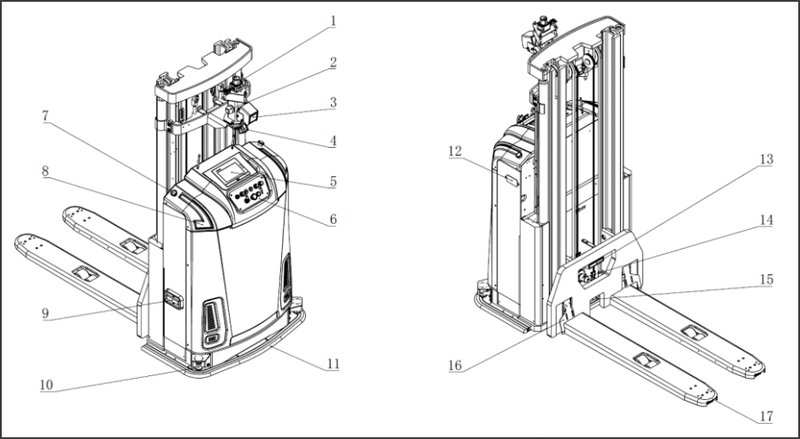
Now we look forward with a comparative lens. Classic AGV logic follows a fixed path and stops at trouble. Newer systems run sensor fusion with lidar SLAM, vision checks, and safer fork approach. They track context and choose better moves. A modern automatic pallet stacker can coordinate with upstream picks and docks via APIs, not just simple triggers. That means fewer blind waits. Model predictive control can smooth lift and travel so pallets settle faster. Fleet management uses event rules, so one unit backs off while another overtakes. Small gains, big compounding. And if an aisle shifts layout, the map updates in minutes, not days—this is the new baseline. We also see stronger power profiles: smart BMS predicts charge windows; power converters balance draw to keep lift speed steady during rush periods.
Principles, not hype, drive the change. Keep the plan near the work. Push decisions to the edge when seconds matter. Keep recovery graceful when the world is messy. In practice, that means tighter WMS and MES links, simple exception UX, and clean telemetry. It also means you compare systems by flow impact, not brochure speed. Summing up the earlier pains—handoff delays, weak alignment, and dead zones—the next wave aims to absorb them by design. The right stacker should cut queue tails, hold placement accuracy at height, and keep dispatch alive even with spotty radio (it will happen—funny how that works, right?). To choose well, use three clear metrics: 1) throughput per hour per square meter under mixed SKUs, 2) 90th-percentile dock-to-shelf time with and without exceptions, 3) effective uptime (MTBF minus recoveries) over a full shift pattern. Stay consistent on these, and your comparison will be fair and simple. For readers who want the engineering depth without the hype, you may also watch how vendors document safety PLC logic and edge compute failover; those pages tell the truth.

In the end, the path is quite practical. Compare on flow, test exceptions early, and watch the variance line. If the system keeps promise under noise, it is a fit. If it only shines in a demo lane, think twice. Shared learning helps our whole field move forward. For more technical notes and applied cases, see SEER Robotics.